
Building Harmonic Protocols
If you would like to build your own harmonic protocol, some basic choices and ideas are presented below.
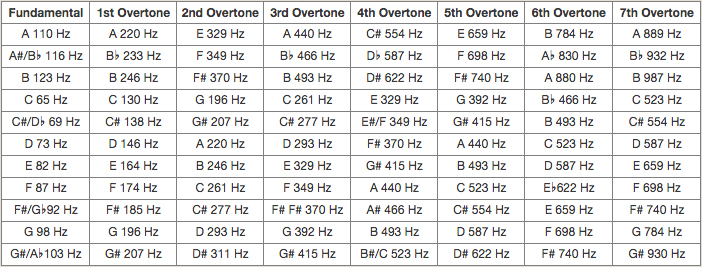
- Choose a fundamental you would like to work with from the chart below entitled Fundamentals and their First Seven Overtones. (For example, the note A.) The fundamental and its first seven overtones are the notes you will be using in your exercise. Tones are listed in the mathematical order in which they unfold. The fundamental is usually sounded first. It’s best to use to overtones in sequential order at first so that the brain learns the progression. Then they can be used in any order.
Fundamentals and their First Seven Overtones
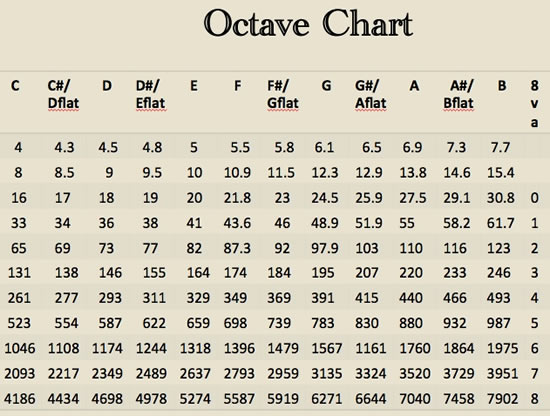
- Choose the octave range you would like to use. (Higher range usually is good for focus, lower range for relaxation. Here are two charts to guide you—the first to help you choose an octave range and the second to help you hop around different octave ranges mathematically.
Range of Low to High Frequencies (Middle C on the piano is 261 Hz)

Mathematical Ratios of Octaves Based on Different Musical Notes Measured in Hertz (Hz)
- Decide what kind of durations you need for the sounds in the protocol. Short sounds are good for immediate acknowledgement that the goal has been achieved and long sounds are good for pauses between sets or consolidation periods. (Short and long sounds can be combined in the same protocol.)
- If you are uncertain what to choose, here is a basic example:
(Piano) Fundamental of C:
- 261 Hz (short) immediate reinforcement tone
- 131 Hz (short) for use after a certain number of goals are achieved
- 66 Hz (long) during pause between exercises
- 131 Hz Overtone series (long) for closing eyes after exercise and consolidating
Or
131 Hz Cycle of 5ths (long) for closing eyes after exercise and consolidating